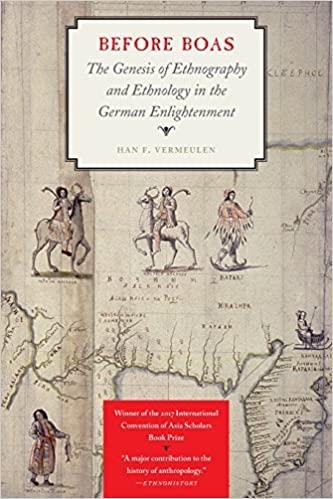
The history of anthropology has been written from multiple viewpoints, often from perspectives of gender, nationality, theory, or politics. Before Boas delves deeper into issues concerning anthropology’s academic origins to present a groundbreaking study that reveals how ethnography and ethnology or...
The history of anthropology has been written from multiple viewpoints, often from perspectives of gender, nationality, theory, or politics. Before Boas delves deeper into issues concerning anthropology’s academic origins to present a groundbreaking study that reveals how ethnography and ethnology originated during the eighteenth rather than the nineteenth century, developing parallel to anthropology, or the “natural history of man.”
Han F. Vermeulen explores primary and secondary sources from Russia, Germany, Austria, the United States, the Netherlands, Hungary, the Czech Republic, Slovakia, France, and Great Britain in tracing how “ethnography” originated as field research by German-speaking historians and naturalists in Siberia (Russia) during the 1730s and 1740s, was generalized as “ethnology” by scholars in Göttingen (Germany) and Vienna (Austria) during the 1770s and 1780s, and was subsequently adopted by researchers in other countries.
Before Boas argues that anthropology and ethnology were separate sciences during the Age of Reason, studying racial and ethnic diversity, respectively. Ethnography and ethnology focused not on “other” cultures but on all peoples of all eras. Following G. W. Leibniz, researchers in these fields categorized peoples primarily according to their languages. Franz Boas professionalized the holistic study of anthropology from the 1880s into the twentieth century.
Este sitio web almacena datos como cookies para habilitar la funcionalidad necesaria del sitio, incluidos análisis y personalización. Puede cambiar su configuración en cualquier momento o aceptar la configuración predeterminada.
Las cookies necesarias ayudan a hacer una página web utilizable activando funciones básicas como la navegación en la página y el acceso a áreas seguras de la página web. La página web no puede funcionar adecuadamente sin estas cookies.
Personalización
Las cookies de personalización permiten a la página web recordar información que cambia la forma en que la página se comporta o el aspecto que tiene, como su idioma preferido o la región en la que usted se encuentra.
Análisis
Las cookies estadísticas ayudan a los propietarios de páginas web a comprender cómo interactúan los visitantes con las páginas web reuniendo y proporcionando información de forma anónima.
Marketing
Las cookies de marketing se utilizan para rastrear a los visitantes en las páginas web. La intención es mostrar anuncios relevantes y atractivos para el usuario individual, y por lo tanto, más valiosos para los editores y terceros anunciantes.