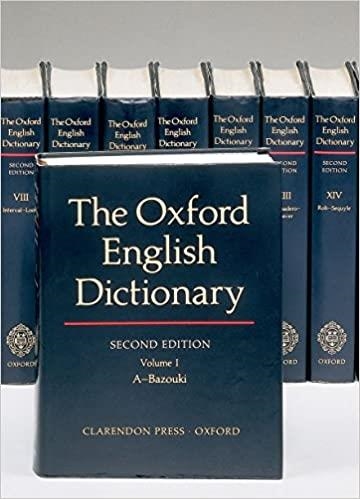
The 20-volume Oxford English Dictionary is the accepted authority on the evolution of the English language over the last millennium. It traces the usage of words through 2.4 million quotations from a wide range of international English language sources. The OED has a unique historical focus. Accompa...
The 20-volume Oxford English Dictionary is the accepted authority on the evolution of the English language over the last millennium. It traces the usage of words through 2.4 million quotations from a wide range of international English language sources. The OED has a unique historical focus. Accompanying each definition is a chronologically arranged group of quotations that trace the usage of words, and show the contexts in which they can be used. The quotations are drawn from a huge variety of sources worldwide - literary, scholarly, technical, and popular - and represent authors as disparate as Geoffrey Chaucer and Erica Jong, William Shakespeare, Charles Darwin and Isabella Beeton. Other features distinguishing the entries in the Dictionary are authoritative definitions; detailed information on pronunciation using the International Phonetic Alphabet; listings of variant spellings used throughout each word's history; extensive treatment of etymology; and details of area of usage and of any regional characteristics. Alongside the print edition is the Oxford English Dictionary Online (www.oed.com). Updated quarterly, this award-winning online resource allows the Dictionary to evolve with the English language while the print edition remains as a historical record. Subscriptions are available to OED online on an individual or institutional basis. Visit www.oup.com/online/oed/ for details.
Este sitio web almacena datos como cookies para habilitar la funcionalidad necesaria del sitio, incluidos análisis y personalización. Puede cambiar su configuración en cualquier momento o aceptar la configuración predeterminada.
Las cookies necesarias ayudan a hacer una página web utilizable activando funciones básicas como la navegación en la página y el acceso a áreas seguras de la página web. La página web no puede funcionar adecuadamente sin estas cookies.
Personalización
Las cookies de personalización permiten a la página web recordar información que cambia la forma en que la página se comporta o el aspecto que tiene, como su idioma preferido o la región en la que usted se encuentra.
Análisis
Las cookies estadísticas ayudan a los propietarios de páginas web a comprender cómo interactúan los visitantes con las páginas web reuniendo y proporcionando información de forma anónima.
Marketing
Las cookies de marketing se utilizan para rastrear a los visitantes en las páginas web. La intención es mostrar anuncios relevantes y atractivos para el usuario individual, y por lo tanto, más valiosos para los editores y terceros anunciantes.